The sourcing decision most buyers get wrong
Most brands and importers evaluate pull-out cabinet organizer suppliers the same way: they compare unit prices, pick the lowest quote, and place an order.
Six months later, the problems arrive with the container. Slide rails that bind after thirty cycles. Powder coating that chips at the weld points. Basket dimensions that are 3 mm off spec — close enough to pass a photo review, but wrong enough to fail a retail compliance check.
The mistake is not choosing the wrong price. The mistake is evaluating the wrong things at the wrong stage.
This guide walks through what to actually assess when sourcing a pull-out cabinet organizer manufacturer — whether you are developing a new SKU for a private label program, scaling an existing product line, or qualifying a second-source supplier.
What "pull-out cabinet organizer" actually covers
Before evaluating suppliers, it helps to be precise about product scope, because the manufacturing requirements differ significantly across sub-types.
Single-tier pull-out baskets are the most common entry point — a wire or powder-coated steel basket mounted to a side-mount or bottom-mount slide rail. Simple geometry, high volume, tight tolerances on the rail-to-basket interface.
Double-layer and multi-tier systems require more precise stamping and consistent weld geometry. If the two basket levels are not parallel within 1–2 mm, the slide binds under load.
Adjustable-width organizers depend on a telescoping frame mechanism. The adjustment range, locking mechanism, and corrosion resistance of the adjustment points all need specification and testing.
Under-sink and pantry pull-outs often need custom depth and height to work within specific cabinet openings — which means the manufacturer must handle tooling development in-house, or your lead time doubles while they outsource it.
Knowing which sub-type you are buying determines which factory capabilities are actually relevant.
The five capabilities that separate reliable manufacturers from low-price commodity suppliers
1. In-house tooling and mold development
Pull-out cabinet organizers are not standard off-the-shelf products. The moment a buyer wants a specific basket width, a proprietary handle profile, or a branded powder coat color, tooling is required.
Factories that outsource tooling to a third party add 15–30 days to sample lead time, lose direct control over tool quality, and cannot iterate quickly when a sample needs adjustment.
What to ask: "Where are your tooling and molds produced? Can we visit the tooling department during a factory audit?"
A factory with in-house tooling should be able to deliver first samples within 7–10 business days from drawing confirmation. If the answer is longer, ask why.
2. In-house surface finishing
Pull-out baskets fail in two ways in the field: the slide mechanism fails, or the surface corrodes. Surface finishing — powder coating, chrome plating, or electrostatic painting — is the primary line of defense against corrosion.
Outsourced finishing introduces inconsistency. Batch color variance. Adhesion differences between runs. A factory that finishes in-house controls the pre-treatment stage (phosphating or sandblasting), coating thickness, and cure temperature — all of which directly affect how long the finish lasts under kitchen humidity conditions.
Ask for salt spray test data. An acceptable benchmark for kitchen storage products is 48–72 hours of salt spray resistance with no base metal corrosion. Factories with in-house finishing labs can provide this data from actual production batches, not just from a single certified sample.
3. Slide rail sourcing and specification control
The slide rail is the most failure-prone component in a pull-out organizer system. A basket that operates smoothly in a sample can bind, rattle, or fail under repeated load if the rail is underpowered for the application.
Two things matter: load rating and cycle life. A kitchen under-cabinet pull-out should handle at least 25–35 kg dynamic load and 30,000+ open-close cycles without degradation in operation.
Ask the manufacturer to specify the rail brand and model, and request the technical data sheet. If they cannot provide it, they are buying on price rather than specification — which is your risk, not theirs.
4. Quality control structure
A robust QC process for metal storage products includes incoming material inspection (steel thickness, surface condition, hardness if applicable), in-process dimensional checks (basket geometry, weld quality, rail alignment), and final product testing (load test, cycle test, finish adhesion check).
The question to ask is not "do you have ISO 9001?" (most factories do). The more useful question is: "Walk me through your QC process for a 5,000-piece pull-out basket order. What gets checked, when, by whom, and what is the rejection threshold?"
A factory that can answer this question specifically and confidently has built the process. A factory that answers in generalities probably has not.
5. Certification and compliance documentation
If you are selling into North American or European retail channels, your pull-out organizer products will be subject to buyer compliance requirements at multiple points in the supply chain.
BSCI (Business Social Compliance Initiative) certification is the baseline requirement for most European retail buyers. ISO 9001 demonstrates process discipline. Depending on your end market and product application, you may also need material compliance documentation (REACH for EU, California Prop 65 for US) and product-level test reports.
A manufacturer that has already built the compliance documentation infrastructure — audit reports, test data on file, certifications that are current and transferable — saves you months of pre-qualification work.
Evaluating MOQ and development economics
For most pull-out cabinet organizer programs, the relevant commercial questions are:
What is the minimum order quantity for a tooled custom product? Factories with efficient production lines and in-house tooling can typically accommodate programs from 1,000 pieces per SKU. Factories that require 5,000+ pieces as a minimum for customized products are optimized for commodity volume, not development-stage programs.
How is tooling structured and amortized? Tooling fees for pull-out basket programs typically range from $800–$3,000 per tool depending on complexity. Some manufacturers offer tooling fee rebates on reaching volume milestones. Understand the terms before committing.
What is the prototype-to-production timeline? A credible answer for a metal pull-out organizer with in-house tooling is: first sample in 7 business days, sample revision cycle 3–5 days, bulk production in 30 days from sample approval. Timelines significantly longer than this suggest the factory is relying on third-party tooling or finishing.
What to look for in a factory visit (or remote audit)
If you are qualifying a new pull-out cabinet organizer manufacturer without an in-person visit, request a structured video walkthrough covering:
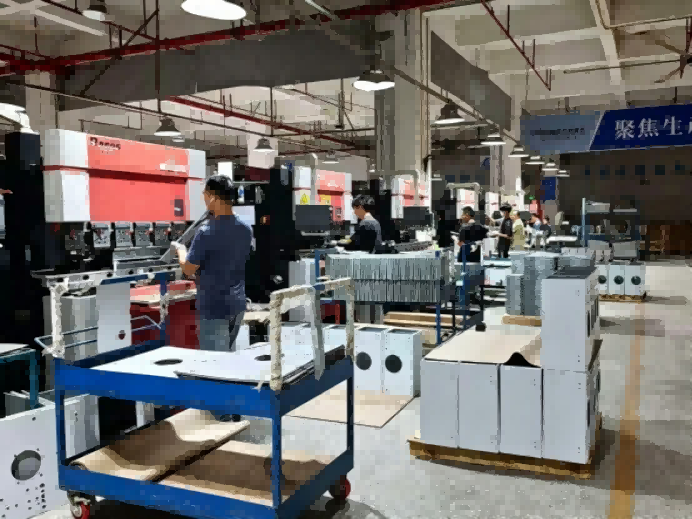
- The stamping and bending floor (look for press capacity, material handling, and production scheduling boards)
- The welding station (TIG or MIG, weld consistency on actual product)
- The powder coating or plating line (pre-treatment tanks, oven, cooling zone)
- The QC lab or inspection station (dimensional gauges, salt spray cabinet, load testing fixture)
- The tooling and mold storage area (organized, labeled, condition of existing tooling)
A factory that resists showing any of these areas warrants a direct follow-up question.
Red flags in supplier communication
Several patterns in early supplier communication signal risk:
Immediate deep discounts without understanding your specification. A manufacturer who cuts price before understanding the product is buying the order with margin they do not have. That margin comes back out somewhere — usually in material quality or QC cut corners.
No push-back on your drawings or specifications. Good manufacturing partners identify problems in the design or specification before production. If a supplier approves everything without engineering feedback, either the engineering capability is limited or the review did not happen.
Vague answers about certification status. "We can get certification" is not the same as "we hold current BSCI certification with an audit date of [X] and can send you the report." The difference matters when a retail buyer asks for documentation on a 60-day clock.
Prototype delivery that takes more than two weeks. In-house tooling capability is best demonstrated, not claimed. A factory that says it has in-house tooling but takes four weeks to deliver a first sample is probably outsourcing.
Building a long-term manufacturing partnership
The best outcome of a pull-out cabinet organizer sourcing project is not a single order. It is a manufacturing relationship that supports your product development pipeline over multiple seasons.
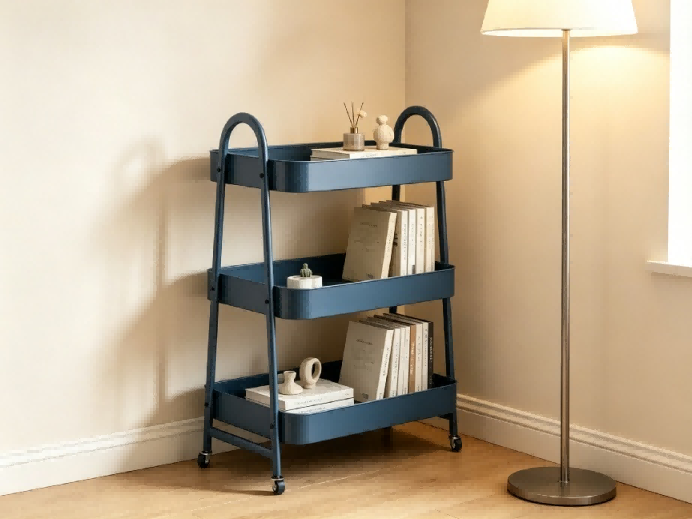
That means selecting a manufacturer with the platform capacity to grow with you — from pull-out kitchen organizers into bathroom racks, rolling storage carts, and broader metal storage systems — without switching factories every time you expand your category.
It also means selecting a partner who operates exclusively on a B2B OEM/ODM model, without selling the same products through retail channels or marketplace platforms that compete with your own listings.
About Winner Sheet Metal
Winner Sheet Metal is a B2B OEM/ODM manufacturer founded in 1999, operating from a 60,000 sqm facility in Zhongshan, Guangdong, China, with 500+ employees.
We manufacture pull-out cabinet organizers, rolling storage carts, metal storage racks, bathroom shelving, and folding step stools for brands, importers, and retail supply buyers in North America and Europe.
Our full manufacturing capability — tooling, stamping, fabrication, powder coating, assembly, and testing — operates in-house. ISO 9001 and BSCI certified.
Prototype delivery within 7 business days. Standard production in 30 days. MOQ from 1,000 pieces.
Start your OEM/ODM project →